Aligning with International Standards: The Case for Reforming Norwegian Family Law
🌐EN
📅February 17, 2026
💡 How to use: Use zoom buttons or scroll wheel to zoom in/out. Click and drag to pan around when zoomed. Double-click to zoom in. Press Reset to return to original view.
The Bridge Between Norwegian Practice and International Human Rights
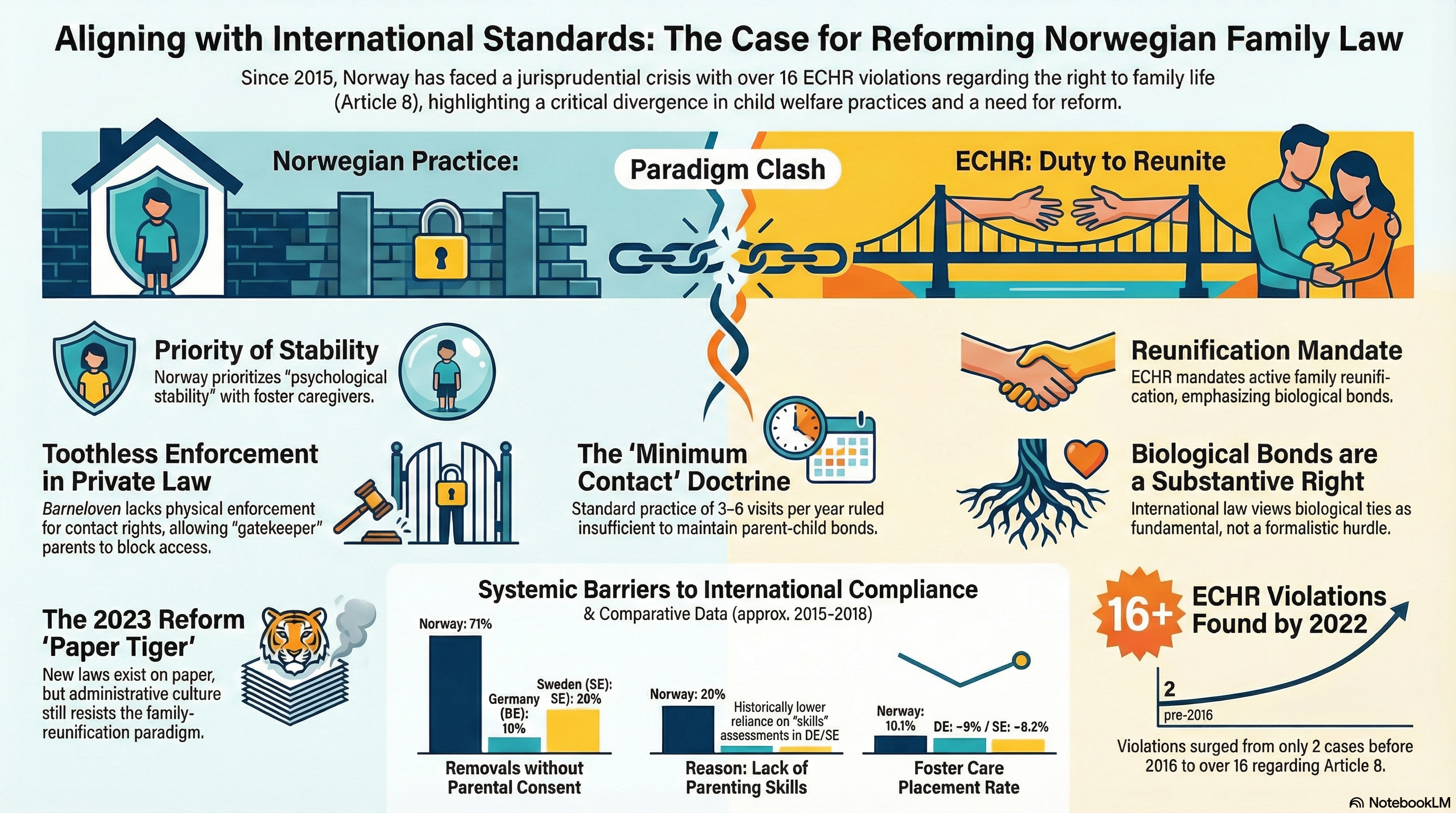
Since 2015, Norway has faced a jurisprudential crisis with over 16 ECHR violations regarding the right to family life (Article 8). This comprehensive infographic visualizes the systemic paradigm clash between Norwegian child welfare practices and international human rights standards, highlighting critical divergence in child welfare practices and the urgent need for reform.
⚖️ Norwegian Practice vs. ECHR Mandates
🇳🇴 Norwegian Approach
Priority of Stability: Emphasis on "psychological parent" model (foster care permanency)
Limited Contact: The "Minimum Contact" doctrine with 3-6 visits per year
Toothless Enforcement: Recognition of biological bonds without legal enforcement in private law
Goal: Immediate stability and "peace" for the child
🇪🇺 ECHR Requirements
Reunification Mandate: Positive obligation to work toward family reunification
Regular Contact: Frequent, meaningful contact to maintain biological bonds
Biological Bonds: Recognition as a substantive right, not merely symbolic
Goal: Ultimate aim of reuniting biological families
📊 Critical Statistics & Timeline
• The Surge: From only 2 violations (1959-2016) to 16+ violations by 2022 — primarily Article 8 (right to family life)
• Foster Care Dominance:71% of removals without parental consent result in long-term foster placement, compared to 10% reunification and 19% alternative outcomes
• The 2023 Reform: Following Strand Lobben v. Norway [GC] (2019) and mounting international pressure, Norway enacted comprehensive legislative reforms
• Paradigm Shift: The reform addresses systemic barriers including standardization as "shield," administrative culture resistance, and lack of enforceable biological parent rights
🔍 Key Areas Requiring Reform
"Standardization as Shield": Ending the practice of minimal contact being justified as "standard procedure"
Cultural Shift: Moving from administrative convenience to genuine reunification efforts
Enforcement Mechanisms: Creating legal pathways for biological parents to challenge decisions
Evidence-Based Practice: Requiring comparative data analysis and proportionality assessments
Administrative Culture: Addressing resistance to change within Barnevernet institutions
⚡ The Paradigm Clash Explained
The fundamental conflict lies in competing ethical frameworks: Norway has historically operated under a virtue ethics model (focusing on the child's immediate wellbeing and "best interests"), while the ECHR mandates a duty ethics framework (emphasizing the state's positive obligations to preserve family unity). This creates systemic friction where Norwegian caseworkers genuinely believe they are acting in children's best interests, yet repeatedly violate international human rights standards.
We use cookies to enhance your browsing experience, serve personalized content, and analyze our traffic. By clicking "Accept All", you consent to our use of cookies.
⚙️
Cookie Settings
Essential Cookies
Required for the website to function properly. These cannot be disabled.
Analytics Cookies
Help us understand how visitors interact with our website.
Marketing Cookies
Used to track visitors across websites to display relevant advertisements.

Comments (0)
Please log in to post comments.