๐Ÿ”„ Process

Breaking the Cycle: Understanding and Resolving Child Contact Refusal

๐ŸŒ EN
๐Ÿ“… February 17, 2026
๐Ÿ’ก How to use: Use zoom buttons or scroll wheel to zoom in/out. Click and drag to pan around when zoomed. Double-click to zoom in. Press Reset to return to original view.

Infographic

Zoom and pan to explore details
100%
Breaking the Cycle: Understanding and Resolving Child Contact Refusal

Content

From Rejection to Reconnection: A Comprehensive Framework for High-Conflict Family Dynamics

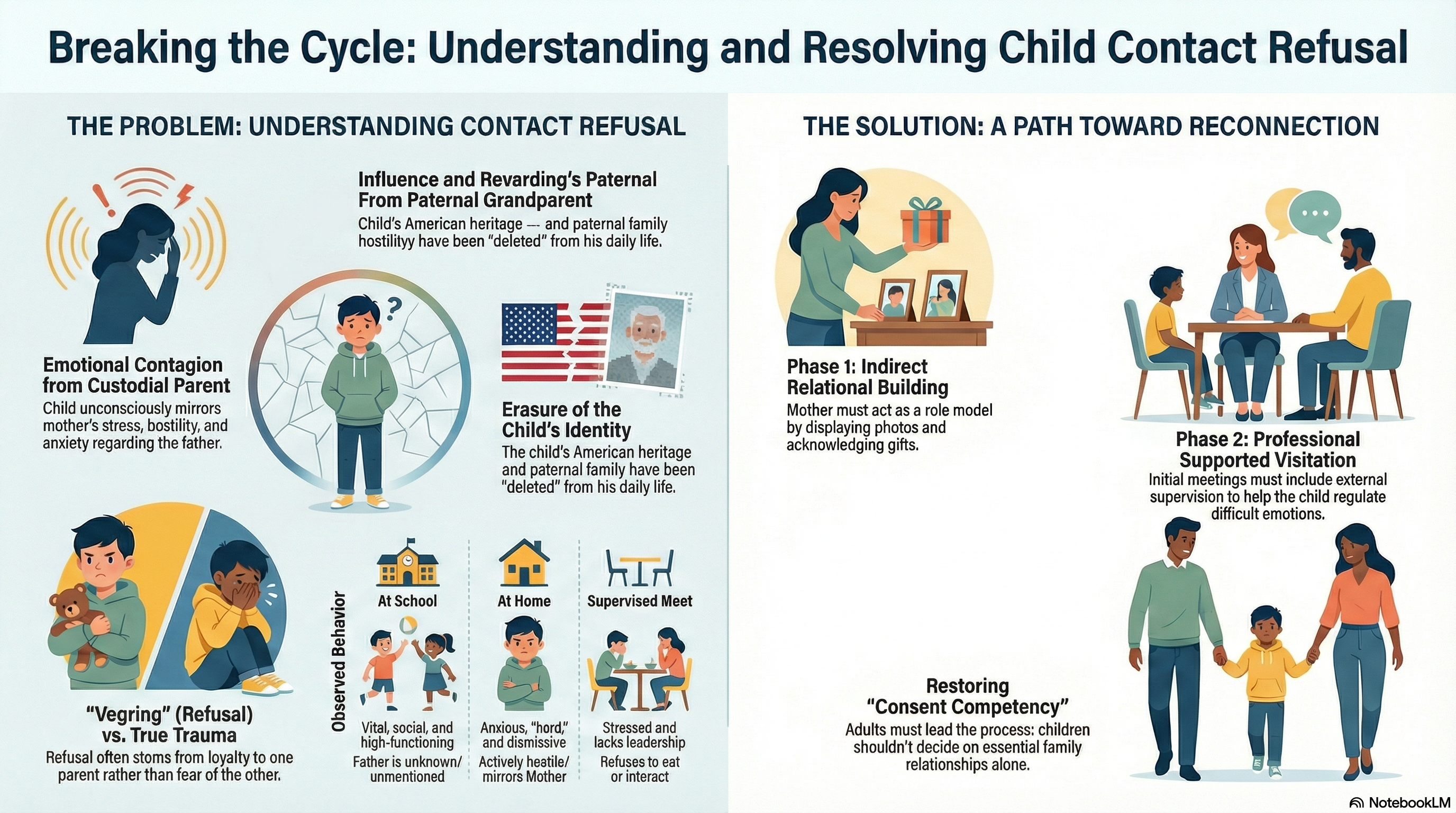
This infographic provides a systematic framework for understanding and resolving child contact refusal in high-conflict separation and divorce cases. It distinguishes between coached rejection ("refusing") and authentic preference ("veering"), while offering a phased clinical pathway to rebuild fractured parent-child relationships. The model addresses the psychological mechanisms behind contact resistanceโ€”including emotional contagion from the custodial parent, mirroring of hostility, and identity erasureโ€”and outlines evidence-based interventions to restore healthy family bonds.

๐Ÿ” The Problem: Understanding Contact Refusal

๐Ÿ˜ฐ Emotional Contagion from Custodial Parent

The child absorbs the custodial parent's stress, hostility, and anxiety regarding the other parent. This creates a "contagion effect" where the child mirrors the mother's emotions, adopting her negative narrative about the father without independent verification.

๐Ÿ”„ "Mirroring" (Refusal) vs. True Resistance

"Refusing" occurs when a child parrots the custodial parent's statements verbatim, showing coached rejection. In contrast, "veering" reflects genuine developmental preference. Refusal often stems from loyalty conflicts rather than actual fear or harm.

๐Ÿšซ Influence and Rewriting Child's Identity

Children in high-conflict situations often experience identity erasure, where one parent's heritage, values, or narrative is systematically "deleted" from the child's self-concept. For example, an American-Norwegian child being taught to identify as "100% Norwegian" while rejecting the American parent.

โš ๏ธ Environmental Context: Functioning Across Settings

A critical diagnostic criterion: Does the child function normally in other environments (school, peers, extracurriculars)? If so, the rejection is relationship-specific, not a global developmental issueโ€”indicating that therapeutic intervention, not continued separation, is the appropriate response.

โœ… The Solution: A Path Toward Reconnection

The framework proposes a three-phase therapeutic model to restore parent-child relationships while protecting the child from harm:

Phase 1: Indirect Relational Building

Begin with low-threat, asynchronous contact: letters, photos, video messages. This allows the child to engage at their own pace without performance pressure, gradually normalizing the rejected parent's presence.

Phase 2: Professional Supervision & Grandparents

Introduce supervised visits in neutral settings with therapeutic oversight. Using grandparents as a "safe bridge" can reduce defensivenessโ€”children are often less resistant to extended family than the rejected parent directly.

Phase 3: "Consent Without Coercion"

Gradually transition to autonomous contact while maintaining therapeutic monitoring. The goal is for the child to internalize a balanced narrative about both parents, freeing them from loyalty conflicts and allowing authentic relationship-building.

๐ŸŽฏ Core Principles: Refusing vs. Veering

๐Ÿšซ "Refusing" (Coached Rejection)

  • Child parrots custodial parent's language verbatim
  • Rejection is absolute ("I hate him," "I never want to see him")
  • Child cannot articulate specific harms or reasons
  • Functions well in other environments (school, peers)
  • Intervention: Therapeutic reunification, not continued separation

โ†”๏ธ "Veering" (Authentic Preference)

  • Child expresses nuanced, age-appropriate reasons
  • Rejection is context-specific, not absolute
  • Child can identify concrete negative experiences
  • May reflect genuine safety concerns or incompatibility
  • Intervention: Address underlying issues, respect child's voice

๐Ÿ“š Evidence Base: Why This Framework Works

  • Attachment Theory: Prolonged separation from a primary caregiver (even if conflicted) creates long-term attachment insecurity and identity confusion.
  • Family Systems Therapy: Contact refusal is a symptom of systemic dysfunction, not individual pathology. Treatment must address the entire family system, including custodial parent's role.
  • Research Outcomes: Studies show that structured therapeutic reunification (e.g., Family Bridges program) significantly improves parent-child relationships with minimal distress when properly implemented.
  • Developmental Psychology: Identity formation (ages 7-14) requires access to both parental narratives. Denying this access causes foreclosure and long-term identity confusion.

Key Sources: Warshak (2010) Family Bridges: Using Insights from Social Science to Reconnect Parents and Alienated Children; Kelly & Johnston (2001) "The Alienated Child"; Baker & Darnall (2006) "Behaviors and Strategies of Parental Alienation"

Related Topics: Contact Refusal, Therapeutic Reunification, Parental Alienation, Loyalty Conflicts, Family Therapy, Child Development, Attachment Disruption, High-Conflict Divorce

๐Ÿ‘ | ๐Ÿ‘Ž 0 dislikes Log in to react
Share:

Comments (0)

No comments yet. Be the first to comment!

โ† Back to All Infographics
โœŠ Sign Our Petition