
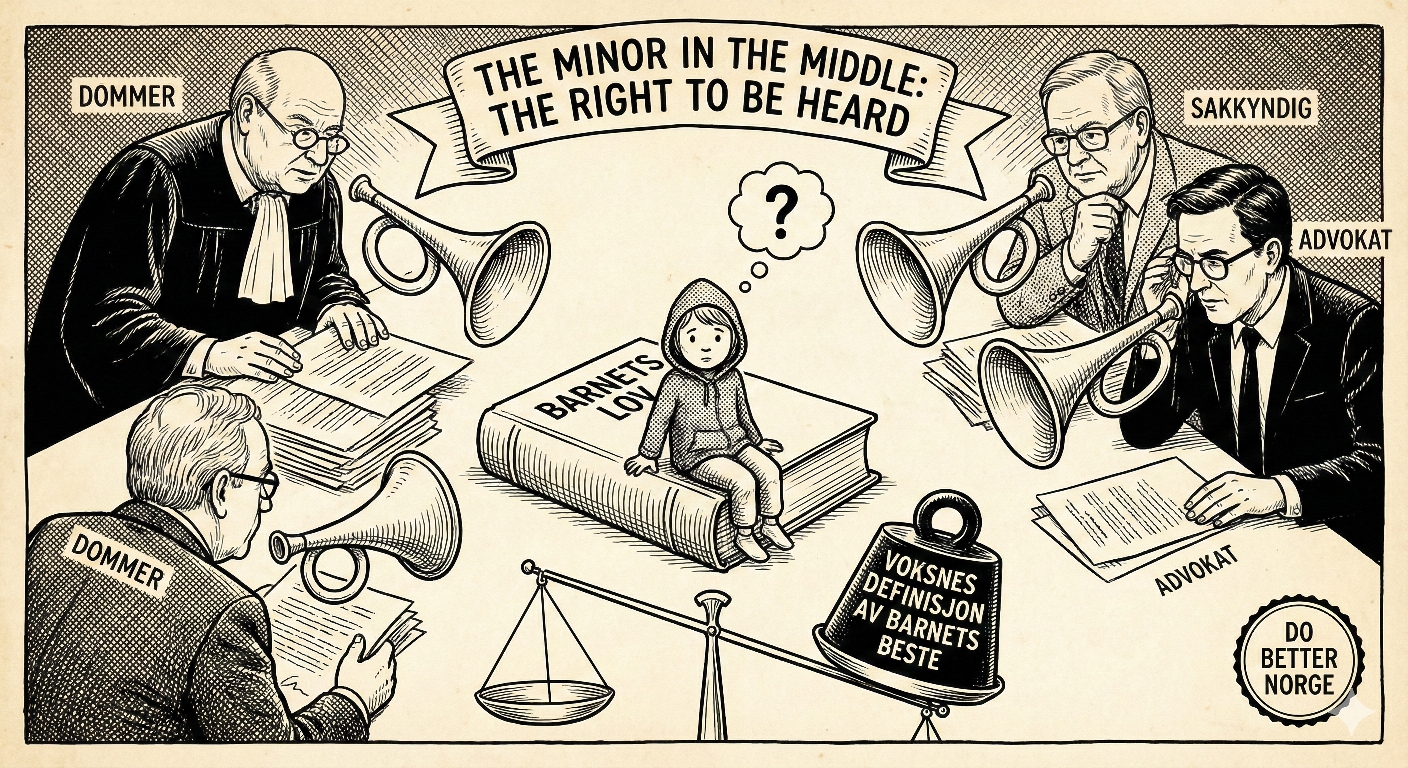
The Minor in the Middle: The Right to be Heard
In Norway, the child’s legal standing in a custody or care dispute is governed by a fundamental paradox: while the child is the subject of the entire case, they are rarely a formal party to the proceedings. Under Section 31 of the Children Act (Barneloven) and Article 104 of the Norwegian Constitution, children have an absolute right to express their views, but the system often struggles to distinguish between "hearing" a child and "listening" to them.
1. The Age Milestones: Legal Weight vs. Maturity
The Children Act establishes specific age thresholds that dictate how much "weight" a judge must give to a child's stated wish. However, these are not rigid borders; even very young children have the right to be heard if they are capable of forming a view.
- Age 7: This is the statutory threshold where the state must ensure the child has an opportunity to speak. The court must assess their maturity and give their opinion weight accordingly.
- Age 12: This is the "Gold Standard" milestone. The law states that the child's opinion shall be given significant weight (stor vekt). While not an absolute veto, it is legally difficult for a judge to rule against the clear, consistent wish of a 12-year-old without providing extraordinary justification.
- Age 15: In cases regarding the Child Welfare Services (Barnevern), a 15-year-old is often treated as a formal party with the right to their own lawyer and the right to appeal decisions independently.
2. How are Children Heard? The Filtered Voice
Children in Norway almost never step foot inside a courtroom. Their voice is filtered through intermediaries, which raises significant concerns regarding the accuracy of the testimony.
- The Expert (Sakkyndig): Most commonly, the court-appointed psychologist interviews the child in a "neutral" setting. The psychologist then interprets the child's words and body language, presenting a summarized version to the judge. The danger here is Interpretation Bias; the child’s literal words may be dismissed by the expert as "symptoms" of a disorder.
- The Spokesperson (Talsperson): In some cases, particularly when Barnevern is involved, a neutral spokesperson is appointed. Their sole job is to tell the court exactly what the child said, without the psychological analysis. This is often a more "pure" version of the child's wish but carries less weight than the expert's report.
- Judicial Conversation: Occasionally, a judge may talk directly to a child in a private chamber. This is rare and usually only happens with older children when the expert's report is contested.
3. The "Manipulation" Critique: Parental Alienation vs. Genuine Choice
A recurring theme in Norwegian family law is the use of Parental Alienation (Foreldrefientlighet) as a tool to silence children. When a child expresses a strong preference to live with Parent A, the system frequently adopts the following defensive narrative:
- The "Pressure" Assumption: The court or expert assumes that the child has been "manipulated" or "brainwashed" by Parent A, rather than acknowledging that the child may simply feel safer or happier with that parent.
- Weaponizing "Attachment": Experts often claim the child is suffering from a "loyalty conflict" or "enmeshment," allowing the judge to dismiss the child's clear wish as being "not in their best interest."
Do Better Norge Insight: The "Right to be Ignored"
Parents must understand that in Norway, the "Child's Best Interest" (Barnets Beste) is a legal concept defined by adults, often in direct opposition to the child's actual wish. If your child’s view is being ignored, you must act strategically.
Actionable Strategy:
- Audit the Interviewer: Investigate the background of the Sakkyndig. Have they been criticized for ignoring children's wishes in previous cases?
- Demand a Talsperson: If you believe the psychologist is biased, ask the court to appoint a Talsperson to provide a verbatim account of the child's wishes.
- Consistency is Key: Ensure your child knows they have the right to be heard. If they tell the expert one thing and the teacher another, the system will use the discrepancy to label them "confused" or "manipulated."
Official Sources and References:
- The Children Act: Barneloven § 31 - The Right to be Heard
- UN Convention on the Rights of the Child: Article 12: Respect for the views of the child
- Norwegian Constitution: Kongeriket Norges Grunnlov § 104
- Academic Critique: University of Oslo (UiO) - Children's right to be heard in custody disputes
Comments (0)
Please log in to post comments.
No comments yet. Be the first to comment!