
Norwegian Institutions: The "Black Box" of Child Custody – An Exhaustive Analysis of Systemic Opacity, Commercial Incentives, and Human Rights Challenges
1. Introduction: The Paradox of the Nordic Model
The Norwegian child welfare system, Barnevernet, occupies a unique and contentious position in the global landscape of social policy. Internationally, and particularly within the Nordic model of governance, it is frequently heralded as the gold standard of state-sponsored child protection—a system amply funded, professionally staffed, and legally mandated to intervene decisively to protect children from neglect and abuse.1 It is a system predicated on the "best interests of the child" (barnets beste), a principle enshrined not only in domestic law but in the UN Convention on the Rights of the Child (CRC). Yet, beneath this veneer of high-functioning welfare statism lies a profound systemic crisis. Domestically, the system is increasingly described by critics, legal scholars, and affected families as a "Black Box"—a closed institutional ecosystem where the mechanics of care, observation, and decision-making are obscured from public scrutiny, and where the transition from "temporary assistance" to "permanent severance" of family ties occurs with a rigidity that has drawn unprecedented condemnation from international human rights courts.2
This report provides an exhaustive, multi-dimensional analysis of the Norwegian child welfare institution. It does not merely catalogue the laws and regulations; rather, it dissects the operational reality of the system—the "law in action" versus the "law in books." It investigates the epistemological crisis of the "observation trap," where confirmation bias in daily reporting calcifies into legal truth.4 It scrutinizes the political economy of care, where the rapid commercialization of the sector has introduced profit motives that conflict with the state's obligation to reunify families.6 It examines the human rights friction points, particularly regarding the "reunification goal" and visitation rights, which have placed Norway on a collision course with the European Court of Human Rights (ECHR).8
The metaphor of the "Black Box" is central to this analysis. It refers to the opacity of the processes that occur once a child is placed in institutional care. The input—a child in crisis—is visible. The output—a legal decision for permanent placement or adoption—is public. But the internal machinery—the daily logs written by shift workers, the "miljøterapi" (environmental therapy) interventions, the suppression of biological contact, and the financial transactions between the state and private equity-owned providers—remains largely invisible to the biological parents and the legal oversight bodies until it is too late to reverse the trajectory of the case.10 This report aims to open that box.
1.1 The Legal Landscape: From the 1992 Act to the 2023 Reform
To understand the current operational reality, one must situate it within the evolving legislative framework. For three decades, the Child Welfare Act of 1992 governed the sector. While revolutionary in its time for establishing a low threshold for intervention, it was criticized for granting excessive discretion to the County Boards (Fylkesnemnda) and for lacking explicit safeguards for the biological family's right to maintain contact.4 The 1992 Act operated on a presumption that the state’s intervention was benevolent and that "stability" for the child was best achieved by shielding them from the "unrest" of their biological origins.
On January 1, 2023, a new Child Welfare Act (Barnevernsloven) entered into force. This legislation was a direct response to the mounting external pressure from the ECHR and internal criticism regarding the quality of care. The new Act explicitly codifies the "reunification goal," mandating that care orders are, in principle, temporary and that the state has a positive obligation to facilitate the rebuilding of the family unit.4 It introduces stricter competence requirements for staff and emphasizes the child’s right to participation. However, legal reform does not immediately translate into cultural change. The "Black Box" is maintained by institutional inertia; the workforce, the physical infrastructure, and the commercial contracts were all established under the logic of the 1992 Act. Consequently, the current system is in a state of friction, where new legal rights collide with old operational habits.4
1.2 The Ideological Conflict: Protection vs. Preservation
The core tension driving the dysfunction in the Norwegian system is the ideological conflict between a "child-centric protectionist" model and the "biological principle" protected by Article 8 of the European Convention on Human Rights (ECHR).
-
The Protectionist Model: Dominant in Norwegian social work culture, this view posits that a child’s development is contingent on "stability" and "attachment" to their psychological parents (foster parents or institutional carers). From this perspective, contact with biological parents who are deemed "unfit" is a stressor that disrupts the child’s development. The "Black Box" is designed to protect the child from this stress by filtering out the biological family.14
-
The Biological/Human Rights Model: Emphasized by the ECHR, this view asserts that the state has an extremely high threshold for severing family ties permanently. It argues that a child has a right to their identity and lineage, and that "stability" cannot be used as a pretext to engineer a new family for the child without exhaustive efforts to rehabilitate the biological one.8
The divergence between these two models creates the "observation trap" discussed in Section 2: when a Norwegian social worker observes a child crying after a visit with their mother, the protectionist model interprets this as "harmful interaction confirming the need for separation," while the human rights model might interpret it as "grief confirming the strength of the bond." The institution, holding the power of documentation, almost invariably defaults to the former interpretation.14
2. The Epistemology of the "Black Box": Observation, Evidence, and Bias
The foundation of any child custody case is evidence. In the Norwegian system, the primary source of evidence once a child is in care is not the testimony of the parents, nor independent evaluations, but the internal documentation generated by the institution itself. This section analyzes how the "Black Box" manufactures truth through the mechanism of daily logs (dagrapporter) and how cognitive biases are institutionalized into legal facts.
2.1 The Weaponization of Daily Logs (Dagrapporter)
The dagrapport is the atomic unit of the child welfare case file. In institutional settings, staff members are required to document the child’s behavior, mood, intake of food, sleep patterns, and interactions multiple times a day. Over the course of a six-month placement, these logs accumulate into thousands of pages of "contemporary evidence".10
While intended as a tool for continuity of care between shifts, these logs have evolved into a tool of litigation. They suffer from several critical epistemological flaws that turn them into an "observation trap" for the biological family:
-
Subjectivity masquerading as Objectivity: The logs are written by "miljøarbeidere" (environmental workers) who may have varying levels of education (discussed in Section 6). The entries often blur the line between observation ("the child cried for 10 minutes") and interpretation ("the child cried due to a loyalty conflict triggered by the phone call with mother"). Once written, the interpretation becomes the historical record. The nuance of the situation—that the child might have been tired, hungry, or simply missing their parent—is lost.14
-
The Fatigue Factor and Shift Work: Logs are often written at the end of long shifts or during night shifts by staff suffering from fatigue. Research into decision-making in child welfare suggests that under conditions of high cognitive load and fatigue, professionals rely heavily on heuristics and stereotypes rather than nuanced analysis. A tired worker is more likely to log "non-compliant behavior" than to detail the complex antecedents of a conflict.5
-
Lack of Contextual Rebuttal: Parents are rarely given real-time access to these logs. While they have a legal right to access documents under the Public Administration Act (Forvaltningsloven), in practice, this access is often delayed or provided in bulk shortly before a hearing. This prevents parents from providing contemporaneous context (e.g., "The child was crying because their pet died, not because of my phone call"). By the time the parent sees the log, the narrative has solidified.10
2.2 Confirmation Bias and the "Miljøarbeider" Gaze
The "Black Box" operates on a presumption of parental unfitness. Once a child is placed in care, the institution’s primary mandate is to justify the placement and ensure the child’s integration into the new environment. This creates a structural confirmation bias.
Research on decision-making errors in child welfare identifies "confirmation bias" as a pervasive systemic failure. Professionals tend to selectively seek out and interpret information that supports their pre-existing hypothesis.5 In the Norwegian context, the hypothesis is that "the child is damaged, and the parents are the cause."
-
Positive behaviors by the child are attributed to the "calm and stability" of the institution.
-
Negative behaviors by the child are attributed to "trauma from the parents" or "negative reactions to visitation."
This dynamic is reinforced by the "Kinship Defense" vs. "Child Rescue" paradigms. Institutional staff, viewing themselves as "rescuers," are cognitively primed to view the parents as threats. This bias is not necessarily malicious; it is a cognitive byproduct of the role they have been assigned. However, when these biased observations are codified in daily logs, they become "objective evidence" in the eyes of the County Board.21
2.3 The "Interpretive Monopoly" and Standardized Tools
The institution holds an interpretive monopoly over the child's life. Unlike in a school setting, where teachers and parents share authority, in a care order scenario, the parents are disenfranchised. This monopoly is fortified by the use of standardized assessment frameworks, such as the Kvello Assessment Framework.22
These tools are designed to structure observation and reduce variability. However, they often lead to the "proceduralization" of judgment. Complex human interactions are reduced to checkboxes or standardized categories of risk. A critique of the Kvello framework reveals that it can create gaps in the chain of argument, where broad conclusions about "parental capacity" are drawn from narrow, decontextualized observations. The tool gives the appearance of scientific rigor to what is essentially a subjective assessment, making it harder for parents to challenge the findings in court. The "Black Box" uses these tools to translate the messy reality of a child's life into the clean, binary language of the legal system.22
2.4 Cultural Blindness as Systemic Bias
The "observation trap" is particularly acute for families with immigrant backgrounds. Approximately 29% of children receiving interventions have an immigrant background, yet the system struggles with "cultural competence".23
Research indicates that while Norwegian legislation requires a "cultural perspective," expert assessments rarely employ critical reflection regarding culture. Behaviors that are normative in other cultures (e.g., co-sleeping, intense emotional expression, deferential behavior to adults) can be pathologized by Norwegian staff viewing them through a Nordic middle-class lens.
-
A child who is quiet and deferential might be labeled "inhibited" or "fearful" rather than "respectful."
-
A parent who expresses loud grief during a visit might be labeled "emotionally unregulated" or "scary to the child."
This "cultural blindness" acts as a force multiplier for confirmation bias. The "Black Box" translates cultural difference into developmental deficit, and because the interpreters (institutional staff) lack cultural competence, the error is rarely caught before it becomes legal fact.23
2.5 Access to Documents (Innsynsrett): The Bureaucratic Wall
The transparency of the "Black Box" is theoretically guaranteed by the right to access documents (innsynsrett). Parents and children over 15 have the right to see their journals.10 However, the Sivilombudet (Parliamentary Ombudsman) has repeatedly criticized the handling of these requests.
-
Exceptions and Redactions: Institutions frequently redact information, citing the "child's best interest" or the protection of third parties (e.g., other residents or staff). In some cases, entire documents are withheld because they are deemed "internal working documents".20
-
The "Data Dump" Strategy: When access is granted, it often comes in the form of thousands of pages of unorganized, handwritten, or repetitive logs. This overwhelms the parents and their legal counsel. Finding the specific log entry that contradicts a negative expert assessment requires a forensic level of effort that most families cannot afford.25
-
Correction of Errors: Even if a factual error is found (e.g., "Mother arrived late for visit" when she was actually on time), the system for correcting journals is flawed. The original error is rarely deleted; it is merely annotated, meaning the negative impression remains visible to every future reader of the file.18
3. The Political Economy of Care: Commercialization and Incentives
The "Black Box" is not just a legal or social construct; it is a financial one. The Norwegian child welfare sector has undergone a profound transformation over the last two decades, shifting from a state-dominated model to one where private commercial actors play a dominant role. This "welfare industrial complex" introduces economic incentives that can conflict with the clinical and legal goals of the system.
3.1 Market Structure: The Oligopoly of Care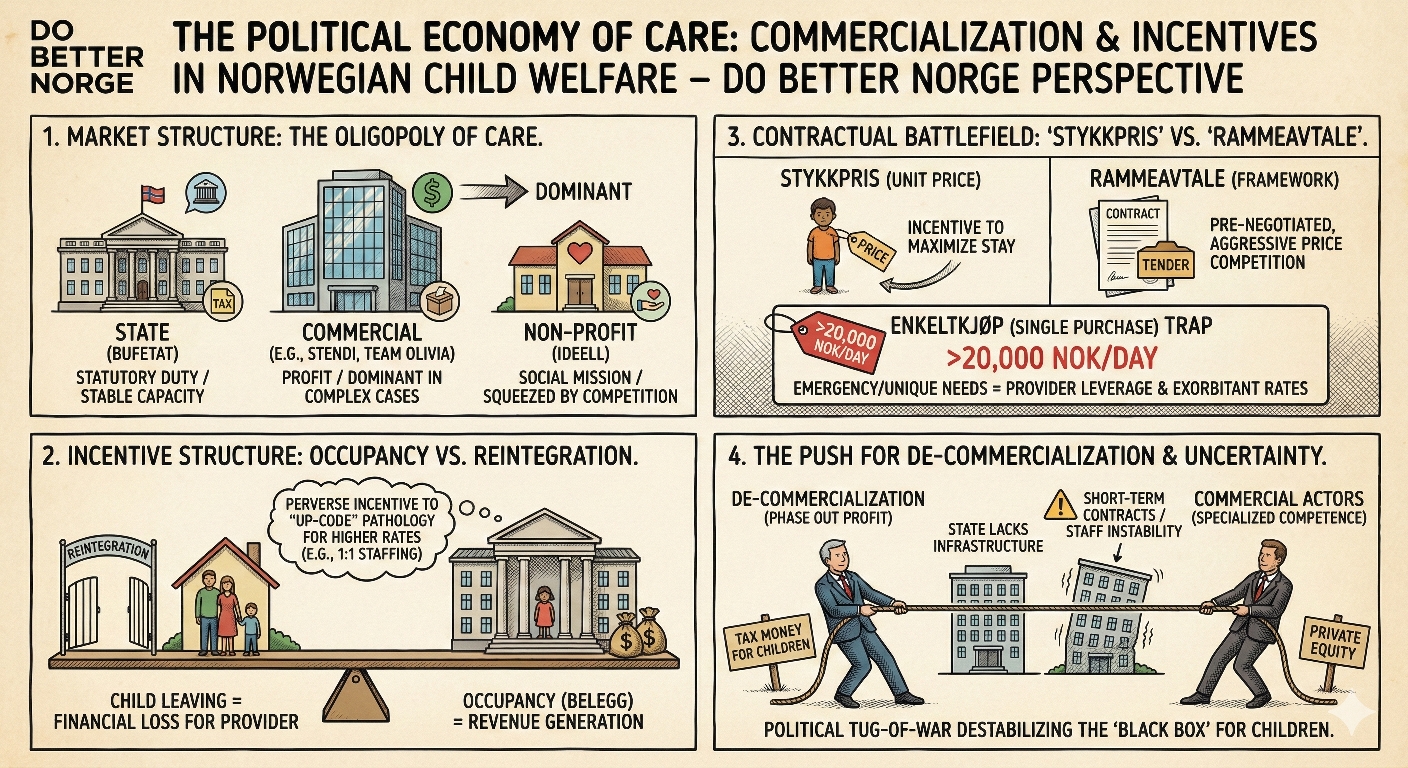
The market for institutional care in Norway is characterized by a mix of state-run (Bufetat), non-profit (ideell), and commercial (kommersiell) providers. However, the commercial segment is dominated by a few large conglomerates, most notably Stendi (formerly Aleris Ungplan & BOI), Team Olivia, and Human Care.7 These companies are often owned by international private equity funds, which brings a profit-maximization logic into the heart of child welfare.
Table 1: Institutional Ownership Structure
|
Actor Type |
Primary Goal |
Funding Source |
Key Players |
Market Share Trend |
|
State (Bufetat) |
Statutory Duty |
National Budget |
Bufetat Regions |
Stable/Declining Capacity |
|
Commercial |
Profit / Efficiency |
Tenders (Anbud) |
Stendi, Team Olivia |
High / Dominant in Complex Cases |
|
Non-Profit (Ideell) |
Social Mission |
Grants / Tenders |
Church City Mission, Frelsesarmeen |
Squeezed by competitive tendering |
The consolidation of the market means that the state is often dependent on a handful of suppliers for its most complex cases. When Bufetat lacks capacity (which is frequent), it must purchase places from these commercial giants.6
3.2 The Incentive Structure: Occupancy vs. Reintegration
The central critique of the commercial model is the misalignment of incentives. Commercial institutions generate revenue based on occupancy (belegg).
-
The Reintegration Paradox: The legal goal of child welfare is reunification (returning the child home) or moving the child to a less restrictive setting (foster home). However, for a commercial institution, a child leaving is a loss of revenue. A "successful" outcome (reunification) is a financial loss for the provider.7
-
Incentive to "Up-code": Institutions are often paid higher daily rates for children with "complex" needs (requiring higher staffing ratios, e.g., 1:1 or 2:1). This creates a perverse incentive to document and emphasize pathology. A daily log that describes a child as "stable and ready for home" threatens the institution's revenue stream. A log that describes the child as "volatile and requiring constant supervision" justifies the continuation of a high-cost contract. This aligns the financial interest of the provider with the "confirmation bias" of the observation trap described in Section 2.7
3.3 "Stykkpris" vs. "Rammeavtale": The Contractual Battlefield
The financial relationship between the state (Bufetat) and private providers governs the "Black Box."
-
Stykkpris (Unit Price): Historically, the system relied on buying individual places at a set daily rate. This incentivized providers to maximize the length of stay for each child.
-
Rammeavtaler (Framework Agreements): In an attempt to control costs and quality, Bufetat has moved toward framework agreements. These contracts pre-negotiate prices and standards. However, to win these tenders, commercial providers often engage in aggressive price competition.
-
The "Enkeltkjøp" (Single Purchase) Trap: When framework agreements are full or a child has unique needs not covered by the framework, the state must make a "single purchase" (enkeltkjøp). In these situations, the provider holds all the leverage and can charge exorbitant daily rates, sometimes exceeding 20,000 NOK per day. This drains the overall welfare budget and incentivizes providers to keep capacity "off-contract" to capture these high-margin emergency placements.27
3.4 The Push for De-commercialization
The current political climate in Norway involves a push for "avkommersialisering"—phasing out commercial profit from the welfare sector. The government argues that tax money should go to children, not private equity dividends. However, removing commercial actors is logistically difficult. The state lacks the infrastructure to immediately replace the thousands of beds provided by Stendi and others. Furthermore, commercial actors argue that they provide specialized competence and flexibility that the rigid state bureaucracy cannot match. This political tug-of-war creates uncertainty in the sector, leading to short-term contracts and staff instability, further destabilizing the "Black Box" for the children living inside it.6
4. The Human Rights Collision: The ECHR Judgments and Visitation
The "Black Box" has recently been subjected to intense light from the outside: the European Court of Human Rights (ECHR) in Strasbourg. Since 2015, Norway has faced a barrage of convictions for violating Article 8 of the European Convention on Human Rights (Right to Respect for Private and Family Life).
4.1 The Strand Lobben Earthquake
The watershed moment was the Grand Chamber judgment in Strand Lobben and Others v. Norway (2019). The Court found that Norway violated Article 8 by severing family ties without adequate justification. The key criticisms were:
-
Premature Permanence: The Norwegian system operated on a de facto presumption that care orders were permanent, failing to actively work towards the "ultimate aim of reunification".3
-
Visitation as a Token: The Court blasted the practice of granting minimal visitation (e.g., 3-6 times a year). Such limited contact makes it impossible for biological bonds to survive, effectively pre-determining that reunification will never happen because the child "no longer knows the parent".13
-
Flawed Balancing: The Court argued that the Norwegian "best interests" assessment was too one-sided, focusing entirely on the child's integration into the foster/institutional setting while ignoring the long-term value of biological ties.8
4.2 The "Reunification Goal": Law vs. Practice
Following these judgments, the Norwegian Supreme Court (Høyesterett) adjusted its jurisprudence to align with the ECHR, and the 2023 Child Welfare Act codified the reunification goal. However, inside the institutions, the culture of "stability first" persists.
The "Black Box" resists reunification through the "stability narrative." Institutional reports often argue that the mere prospect of reunification creates "unrest" (uro) in the child. Therefore, to protect the child's peace of mind, reunification work is stalled. The ECHR has explicitly rejected this logic, stating that the "need for peace" cannot override the fundamental right to family life unless there are exceptional circumstances.8
4.3 The Mechanics of Visitation (Samvær)
Visitation (samvær) is the primary mechanism for maintaining ties, but its implementation often dooms it to failure.
-
The Artificial Setting: Visits often occur in sterile "samværsleiligheter" (visitation apartments) or institutional meeting rooms. These environments lack the texture of normal life—there is no cooking, no cleaning, no homework. This artificiality makes "parenting" impossible; parents become "visitors" in their child's life.33
-
Supervision (Tilsyn) as Surveillance: Visits are frequently monitored by a tilsynsfører (supervisor). This person sits in the room, taking notes. This creates a Panopticon effect. Parents are paralyzed by the fear of being judged. If they discipline the child, they are "too harsh"; if they let the child run wild, they are "lacking boundaries." The supervisor’s logs become part of the case file, often interpreting parental anxiety as "lack of parenting skills".35
-
Interpreting Reactions: The "interpretive monopoly" is most visible here.
-
Child cries on arrival: "Child is traumatized by parent."
-
Child cries on departure: "Parent has upset the child."
-
Child is indifferent: "No attachment exists."
Almost any emotional reaction can be twisted to support a reduction in visitation. The system rarely considers that the constraints of the visit itself (the room, the guard, the time limit) are the cause of the distress, not the parent.14
4.4 The "Loyalty Conflict" Weapon
A pervasive concept in Norwegian child welfare is the "loyalty conflict." Institutions argue that frequent contact places the child in a painful conflict between their loyalty to the foster parents/institution and their biological parents. To "relieve" the child, the system cuts the biological tie.38
Critics and the ECHR argue that this solution is disproportionate. The state’s duty is to resolve the conflict by supporting the child to hold both identities, not to solve the problem by erasing one of them. By eliminating the biological parent, the system creates a "void" that may manifest as trauma in adolescence, but in the short term, it creates the "quiet" that the institution desires.14
5. Life Inside the Box: Coercion, Control, and Digital Isolation
While much of the debate focuses on the legal status of the child, the physical reality of daily life in a Norwegian barnevernsinstitusjon raises serious human rights concerns regarding personal liberty and privacy.
5.1 The Regime of Coercion (Tvang)
The Child Welfare Act allows for the use of coercion (tvang) and restraint, but strictly under "acute" circumstances to prevent injury or significant damage. However, investigations by the Sivilombudet reveal that coercion is often used routinely.
-
Illegal Searches: Reports have documented routine body searches (kroppsvisitasjon) and room searches without specific suspicion, treating care homes like correctional facilities.39
-
Isolation: The use of "skjerming" (shielding) or isolation is common. While intended to de-escalate violent situations, it can devolve into solitary confinement. Sivilombudet has found cases where children are isolated for days, deprived of social contact, which exacerbates the very behavioral problems it is meant to solve.41
-
Documentation Failures: A recurring finding is that institutions fail to document the use of force accurately. This makes retrospective oversight impossible. If a restraint is not logged as "tvang," it effectively didn't happen in the eyes of the law, shielding the institution from accountability.11
5.2 The Digital Disconnect: Mobile Phone Bans
In the 21st century, the mobile phone is the primary conduit for social life and family connection. Institutions often confiscate phones upon arrival or restrict their use to short, monitored windows.
-
Rationale: Institutions argue this protects the child from "bad influences" (drug networks, abusive parents) or ensures they sleep at night.
-
Rights Violation: Sivilombudet has criticized blanket bans as a violation of the right to communication and private life. Restricting a phone cuts the child off from their support network, their friends, and their ability to document their own treatment. It renders the child voiceless inside the "Black Box," dependent entirely on the institution to mediate their contact with the outside world.43
-
The Control Mechanism: By controlling the phone, the institution controls the narrative. A child cannot call their lawyer or parent to report abuse in real-time. They must wait for a scheduled call, which may be monitored.46
5.3 Institutional Drift and "House Rules"
The gap between law and practice is often filled by "House Rules" (husordensregler). These rules often impose restrictions that go beyond what the law allows (e.g., "no phones after 8 PM," "mandatory participation in cleaning"). While these seem like normal parenting rules, in a state institution, they must have a legal basis if they are enforced through coercion. Sivilombudet has found that institutions often enforce these rules with sanctions that amount to illegal punishment, drifting away from a care-based model to a control-based model.47
6. The Workforce Crisis: Competence, Stability, and the "Vikar" Economy
The legitimacy of the "Black Box" rests on the assumption that the decision-makers inside are experts. However, the workforce reality challenges this assumption.
6.1 The Competence Gap
While the 2023 Act introduces a requirement that, by 2031, 80% of staff in institutions must have a relevant bachelor's degree and leaders must have a master's, the current reality is far from this target. Many "miljøarbeidere" are unskilled or have only vocational training.
-
The Consequence: Complex psychological assessments are often based on the daily observations of staff who lack the clinical training to distinguish between trauma responses, attachment disorders, and normal adolescent rebellion. A 19-year-old unskilled worker writing a log about a "violent" 14-year-old may interpret fear as aggression. This misinterpretation enters the legal record and influences the expert psychologists who rely on these logs for their reports.12
6.2 The Instability of Care: Turnus and Vikarer
Institutional care operates on 24/7 shifts (turnus).
-
The "Medlever" Model: Many private institutions use "medlever" shifts (staff live in for 3-4 days, then are off for 7). While this provides some continuity, it leads to high burnout. When staff are exhausted (sleep deprivation is common), their patience and judgment degrade, increasing the risk of coercion.19
-
The Revolving Door: High turnover and sick leave force institutions to rely on temp agencies (vikarbyråer). A child may wake up to a different adult every day. This fragmentation of care makes the formation of secure attachments—the system's stated goal—impossible.
-
The Epistemic Impact: Temporary staff do not know the child’s history. They are more likely to misinterpret behavior or rely on stereotypes. Their contribution to the daily logs is often generic or focused on behavioral control rather than emotional nuance, further degrading the quality of evidence in the "Black Box".19
7. Oversight and Accountability: The Illusion of Control
Who watches the watchers? The Norwegian system has oversight mechanisms, but they are often reactive rather than proactive.
7.1 Helsetilsynet and the "Deviation" (Avvik) Culture
The Norwegian Board of Health Supervision (Helsetilsynet) and the County Governors (Statsforvalteren) are responsible for supervising institutions. They conduct inspections (tilsyn).
-
The Reality of Inspections: Inspections are often announced in advance, allowing institutions to "clean up." Even unannounced inspections can only capture a snapshot of time.
-
The "Avvik" Problem: The system relies on self-reporting of deviations (avvik). If staff do not report a violation (due to fear of reprisal, lack of time, or normalization of the behavior), the regulator never sees it. Statistics on coercion often show "0" incidents in some homes, which Sivilombudet suggests is not a sign of perfection, but of under-reporting.11
-
Lack of Consequences: When violations are found, the typical response is a report requiring the institution to "change routines." Serious sanctions, such as closing an institution or firing staff, are rare. This creates a culture of impunity where "deviation" is just a paperwork problem, not a rights violation.54
7.2 The County Board (Nemnda): A Rubber Stamp?
The Barneverns- og helsenemnda decides on care orders. It consists of a legal chair, an expert member, and a lay member.
-
Bias in Expertise: The "expert members" are often psychologists drawn from a pool who frequently work for the municipal barnevern. Critics argue this creates an "echo chamber" where the expert aligns with the barnevern’s recommendation to maintain their standing in the professional community.
-
Reliance on Written Evidence: Because the Board relies heavily on the written documents (the daily logs and expert reports discussed above), the "Black Box" effectively controls the narrative before the hearing even begins. The parents' oral testimony struggles to compete with the "weight" of the institutional file.4
8. Conclusion: A System Sealed from Within
The comprehensive analysis of the Norwegian child welfare institution reveals a paradox. It is a system designed with the highest moral intent—to protect the vulnerable—but structurally engineered to function as a "Black Box" that resists scrutiny, correction, and the nuance of human relationships.
The systemic failure is not rooted in a single malicious actor but in the convergence of three powerful forces:
-
Epistemic Closure: The mechanism of evidence generation (daily logs + confirmation bias) creates a closed loop where the institution’s hypothesis of "parental unfitness" is perpetually self-validating.
-
Commercial Inertia: The market logic of the "welfare industrial complex" incentivizes the retention of children and the pathologization of their behavior to secure higher billing rates, directly conflicting with the legal mandate for reunification.
-
Ideological Rigidity: Despite the corrective force of the ECHR, the operational culture remains deeply protectionist, viewing biological bonds as secondary to institutional stability.
For the child inside, the "Black Box" is a total institution. Their voice is mediated, their movement is controlled, their digital life is restricted, and their family is marginalized. For the parent outside, the box is a fortress of bureaucracy, impenetrable to legal challenge and deaf to emotional appeal. Until the transparency of documentation is revolutionized, the commercial incentives are realigned, and the "interpretive monopoly" of the institution is broken, the Norwegian system will likely continue to face condemnation from Europe and deep mistrust from its own citizens.
Table 2: The "Official" Process vs. The "Black Box" Reality
|
Stage |
Official Narrative (Law & Policy) |
Black Box Reality (Practice) |
Primary Source Evidence |
|
Observation |
Objective recording of child's welfare. |
Subjective narratives, confirmation bias, fatigue-driven shortcuts. |
4 |
|
Placement |
Temporary measure; goal is reunification. |
De facto permanent; reunification viewed as "unrest." |
3 |
|
Visitation |
Right to family life; frequent contact. |
Restricted, supervised, sterile environments; used as reward/punishment. |
14 |
|
Daily Life |
Normalcy, care, and participation. |
Coercion, phone bans, isolation, varying staff competence. |
41 |
|
Finances |
State funding for quality care. |
Profit extraction, "up-coding" pathology, contract gaming. |
7 |
|
Oversight |
Robust independent monitoring. |
Retrospective reporting, "deviation" culture, lack of real-time correction. |
11 |
Works cited
-
Norwegian Child Welfare Services - Wikipedia, accessed January 15, 2026, https://en.wikipedia.org/wiki/Norwegian_Child_Welfare_Services
-
Gjenforening og samvær- barnevernets praksis i kjølvannet av EMD-dommene - Norce, accessed January 15, 2026, https://www.norceresearch.no/prosjekter/gjenforening-og-samvaer--barnevernets-praksis-i-kjolvannet-av-emd-dommene
-
Den europeiske menneskerettsdomstolen - Bufdir, accessed January 15, 2026, https://www.bufdir.no/fagstotte/barnevern-oppvekst/emd/
-
Full article: Decisions on contact rights after a care order in Norway from 2008 to 2021: a repeated cross-sectional study in the aftermath of the European Court of Human Rights rulings - Taylor & Francis Online, accessed January 15, 2026, https://www.tandfonline.com/doi/full/10.1080/13691457.2025.2492048?af=R
-
Decision making in child welfare: Errors and their context | Request PDF - ResearchGate, accessed January 15, 2026, https://www.researchgate.net/publication/4824017_Decision_making_in_child_welfare_Errors_and_their_context
-
Privat barnevern er mer lønnsomt enn olje. Men Stortinget stemte ned forslaget om å begrense profitten - Fagbladet, accessed January 15, 2026, https://www.fagbladet.no/nyheter/privat-barnevern-er-mer-lonnsomt-enn-olje-men-stortinget-stemte-ned-forslaget-om-a-begrense-profitten/179479
-
Barnevern som profittarena - For Velferdsstaten, accessed January 15, 2026, https://velferdsstaten.no/wp-content/uploads/2019/11/Barnevern-som-profittarena2019.pdf
-
5. Gjenforeningsmålsettingen, herunder fastsettelse av samvær, accessed January 15, 2026, https://www.nhri.no/rapport/barnevern/5-gjenforeningsmalsettingen-herunder-fastsettelse-av-samvaer/
-
European Court rules on 21 applications against Norway concerning children taken into public care - HUDOC, accessed January 15, 2026, https://hudoc.echr.coe.int/app/conversion/pdf/?library=ECHR&id=003-7744629-10718629&filename=21%20applications%20against%20Norway%20concerning%20children%20taken%20into%20public%20care.pdf
-
Child welfare and parents' rights - What you need to know - Insa advokater, accessed January 15, 2026, https://en.insa.no/artikler/barnevernet-og-foreldres-rettigheter
-
2 Statsforvalterens tilsyn med barneverninstitusjoner - Helsetilsynet, accessed January 15, 2026, https://www.helsetilsynet.no/publikasjoner/rapport-fra-helsetilsynet/2023/oppsummering-av-tilsyn-med-barnevernsinstitusjoner-et-tilstandsbilde/2statsforvalterens-tilsyn-med-barneverninstitusjoner?b=toc_785815
-
A Childs' Right to Family Life when Placed in Public Care; an Analysis of Whether Current Norwegian Practice is in Systematic Contradiction to Human Rights in - Brill, accessed January 15, 2026, https://brill.com/view/journals/chil/29/3/article-p563_563.xml
-
Barnevern: Hvorfor Høyesterett ikke retter seg etter EMD - Scandinavian University Press, accessed January 15, 2026, https://www.scup.com/doi/10.18261/fab.23.1.4
-
'The Norwegian Response' – The Development of Contact Rights in Care Order Cases from the Norwegian Supreme Court in Light of Judgments from the European Court of Human Rights, accessed January 15, 2026, https://www.scup.com/doi/10.18261/ret.48.3.1
-
M.F. v. NORWAY - HUDOC, accessed January 15, 2026, https://hudoc.echr.coe.int/eng?i=001-213406
-
accessed January 15, 2026, https://www.psykologforeningen.no/lonn-og-arbeid/jus-og-arbeidsliv/journal/pasientjournal-og-innsynsrett#:~:text=Hovedregelen%20er%20at%20foreldre%20har,har%20grunner%20som%20b%C3%B8r%20respekteres.
-
Dokumentasjon i journal - omsorgssvikt, vold og seksuelle overgrep - Helse Bergen, accessed January 15, 2026, https://kvalitet.helse-bergen.no/docs/pub/dok50722.pdf
-
Arbeidstid i barneverninstitusjonene og behandlingstiltaket MST - Kudos, accessed January 15, 2026, https://kudos.dfo.no/documents/6568/files/6443.pdf
-
Anonymt tips til Barnevernet ikke mulig : r/norge - Reddit, accessed January 15, 2026, https://www.reddit.com/r/norge/comments/1o1zepg/anonymt_tips_til_barnevernet_ikke_mulig/?tl=en
-
In and out of home care decisions: The influence of confirmation bias in developing decision supportive reasoning - PubMed, accessed January 15, 2026, https://pubmed.ncbi.nlm.nih.gov/25687965/
-
Proceduralisation of decision-making processes: a case study of child welfare practice, accessed January 15, 2026, https://www.tandfonline.com/doi/full/10.1080/2156857X.2022.2088606
-
Utilisation of a cultural perspective in child welfare expert assessments in Norway - Better Care Network, accessed January 15, 2026, https://bettercarenetwork.org/sites/default/files/2025-01/evans-mcginn-et-al-2025-utilisation-of-a-cultural-perspective-in-child-welfare-expert-assessments-in-norway.pdf
-
Immigrant Parents' Experiences of Child Welfare Assessment Processes in Child Maltreatment Cases: Implications for Trust | Barn, accessed January 15, 2026, https://tidsskriftetbarn.no/index.php/barn/article/view/5479/8924
-
Innsyn i dokument i en sak etter barnevernsloven - Sivilombudet, accessed January 15, 2026, https://www.sivilombudet.no/uttalelser/innsyn-i-dokument-i-en-sak-etter-barnevernsloven/
-
Utredning av risiko ved utfasing av rammeavtaler med kommersielle leverandører av institusjonsplasser i barnevernet i Oslo, accessed January 15, 2026, https://osloeconomics.no/wp-content/uploads/2021/03/Utfasing-av-kommersielle-leverandorer-Oslo-Economics.pdf
-
Prisøkning i barnevernkjøp skyldes mer enn mangel på konkurranseutsetting | Anbud365, accessed January 15, 2026, https://anbud365.no/bransjer/helse-omsorg/prisokning-i-barnevernkjop-skyldes-mer-enn-mangel-pa-konkurranseutsetting/
-
Tjenestespesifikk veileder om anskaffelse av helse- og sosialtjenester, accessed January 15, 2026, https://www.anskaffelser.no/verktoy/veiledere/tjenestespesifikk-veileder-om-anskaffelse-av-helse-og-sosialtjenester
-
TILDELINGSBREV TIL BARNE-, UNGDOMS- OG FAMILIEDIREKTORATET 2022 - Regjeringen.no, accessed January 15, 2026, https://www.regjeringen.no/contentassets/e3c03f39789d433a9ade95467740b6ab/tildelingsbrev-bufdir-2022.pdf
-
Rammeavtale for bistand til gjennomføring av offentlige anskaffelser - Doffin, accessed January 15, 2026, https://doffin.no/notices/2025-110431
-
Barnets beste foran profitt - Vestfold og Telemark Arbeiderparti, accessed January 15, 2026, https://vestfoldogtelemark.arbeiderpartiet.no/nyheter/barnets-beste-foran-profitt/
-
Områdegjennomgang av institusjonsbarnevernet - regjeringen.no, accessed January 15, 2026, https://www.regjeringen.no/contentassets/9857eedb0c9c444294d722604c411c09/omradegjennomgang-av-institusjonsbarnevernet_endelig-rapport-desember-2024.pdf
-
gjennomføring av samvær etter omsorgsovertakelse kunnskapsbasert retningslinje - Bufdir, accessed January 15, 2026, https://www.bufdir.no/fagstotte/produkter/samvar--retningslinje-for-gjennomforing-av-samvar-etter-omsorgsovertakelse/
-
Samværsleiligheter - Humana omsorg og assistanse, accessed January 15, 2026, https://www.humananorge.no/barnevern/hjelpetiltak/samvaersleiligheter
-
Samvær med tilsyn i saker etter barneloven - NKVTS, accessed January 15, 2026, https://www.nkvts.no/vitenskapelig-artikkel/samvaer-med-tilsyn-i-saker-etter-barneloven/
-
Utfordringer rundt samvær med tilsyn - Foreldre for alltid, accessed January 15, 2026, https://foreldreforalltid.no/samvaer-med-tilsyn-utfordringer/
-
05 - Refleksjon og evaluering | Norsk Fosterhjemsforening, accessed January 15, 2026, https://www.fosterhjemsforening.no/samvaersreaksjoner/05-evaluering/
-
Barn kan ta på seg skulda for foreldrekonfliktar. Korleis kan kvardagen bli betre for alle?, accessed January 15, 2026, https://www.hvl.no/aktuelt/foreldrekonflikt/
-
Barnevernets akuttinstitusjon for ungdom - Sivilombudet, accessed January 15, 2026, https://www.sivilombudet.no/besoksrapporter/barnevernets-akuttinstitusjon-ungdom/
-
Vedlegg 1 – tabeller og detaljert tallmateriale - Årsrapport Helsetilsynet 2024 | Helsetilsynet, accessed January 15, 2026, https://www.helsetilsynet.no/publikasjoner/arsrapporter/arsrapport-helsetilsynet-2024/vedlegg-1--tabeller-og-detaljert-tallmateriale?b=toc_1107186
-
Artikkel fra årsmelding 2018 - Rutinemessig bruk av tvang på barnevernsinstitusjoner, accessed January 15, 2026, https://www.sivilombudet.no/aktuelt/tortur-forebygging/artikkel-fra-arsmelding-2018-rutinemessig-bruk-av-tvang-pa-barnevernsinstitusjoner/
-
Den skreddersydde enhet - Sivilombudet, accessed January 15, 2026, https://www.sivilombudet.no/wp-content/uploads/2023/06/Besoksrapport-2023-Den-skreddersydde-enhet.pdf
-
GRENSELØS OMSORG - Barneombudet, accessed January 15, 2026, https://www.barneombudet.no/uploads/documents/Publikasjoner/Fagrapporter/Grenselos-omsorg.pdf
-
National recommendations and guidelines in the Nordic countries | NVC, accessed January 15, 2026, https://nordicwelfare.org/en/national-recommendations-and-guidelines-in-the-nordic-countries/
-
Retningslinjer til forskrift 15. november 2011 om rettigheter og bruk av tvang under opphold på barneverninstitusjon (rettighetsforskriften) - Regjeringen.no, accessed January 15, 2026, https://www.regjeringen.no/contentassets/e0c9476c97144f6ab2bf8aa04e0fecb6/rundskriv_om_retningslinjer_til_rettighetsforskriften_20_06_2012.pdf
-
RETTIGHETER, accessed January 15, 2026, https://bibliotek.bufdir.no/BUF/101/Dine_rettigheter.pdf
-
Svar på oppfølging etter Sivilombudsmannens besøksrapport til Jong ungdomshjem - Sivilombudet, accessed January 15, 2026, https://www.sivilombudet.no/wp-content/uploads/2021/09/Sivilombudsmannesn-svar-til-oppolgingsbrev-vedr.-Jong-ungdomshjem-juni-2021.pdf
-
Jong ungdomshjem - Sivilombudet, accessed January 15, 2026, https://www.sivilombudet.no/wp-content/uploads/2020/05/Bes%C3%B8ksrapport-2019-Jong-ungdomshjem.pdf
-
Miljøarbeider - Utdanning.no, accessed January 15, 2026, https://utdanning.no/yrker/beskrivelse/miljoarbeider
-
Oppsummeringsrapport - Statsforvalteren, accessed January 15, 2026, https://www.statsforvalteren.no/siteassets/sf-innlandet/03-barn-og-foreldre/ny-mappe/rapport-fra-tilsyn-med-bemanning-og-kompetanse-2022.pdf
-
KOMPETANSE OG RAMMEBETINGELSER I BARNEVERNINSTITUSJONER - Regjeringen.no, accessed January 15, 2026, https://files.nettsteder.regjeringen.no/wpuploads01/sites/515/2022/11/Oppsummering-av-innspill-fra-institusjonskonferansen-kompetanse.pdf
-
Statens helsetilsyn Årsrapport 2024 - regjeringen.no, accessed January 15, 2026, https://www.regjeringen.no/contentassets/b4d5f528ddb44ac891409ae0f9ab09ea/2024-helsetilsynet-arsrapport.pdf
-
Rapport fra Helsetilsynet om tilsynsfunn og tilsynserfaringer i barnevernet i 2022 og 2023, accessed January 15, 2026, https://www.helsetilsynet.no/presse/nyhetsarkiv/2024/rapport-fra-helsetilsynet-om-tilsynsfunn-og-tilsynserfaringer-i-barnevernet-i-2022-og-2023/
-
Gjennomgang av saker der barn med tilknytning til barnevernsinstitusjon har mistet livet - Helsetilsynet, accessed January 15, 2026, https://www.helsetilsynet.no/globalassets/opplastinger/publikasjoner/rapporter2023/barnevernsrapport_til_bfd_med_vedlegg_2023.pdf
-
1. Sammendrag - stortinget.no, accessed January 15, 2026, https://www.stortinget.no/no/Saker-og-publikasjoner/Publikasjoner/Innstillinger/Odelstinget/2008-2009/inno-200809-037/1/
-
12. Skriftlig og muntlig saksbehandling. Konsentrasjon - stortinget.no, accessed January 15, 2026, https://www.stortinget.no/no/Saker-og-publikasjoner/Publikasjoner/Innstillinger/Odelstinget/2004-2005/inno-200405-110/12/
Høringsnotat Forslag til endringer i barneloven – Samvær under tilsyn av offentlig oppnevnt tilsynsperson m.m. - Regjeringen.no, accessed January 15, 2026, https://www.regjeringen.no/globalassets/upload/bld/forslag_endringer_barneloven_pdf.pdf
Comments (0)
Please log in to post comments.
No comments yet. Be the first to comment!