
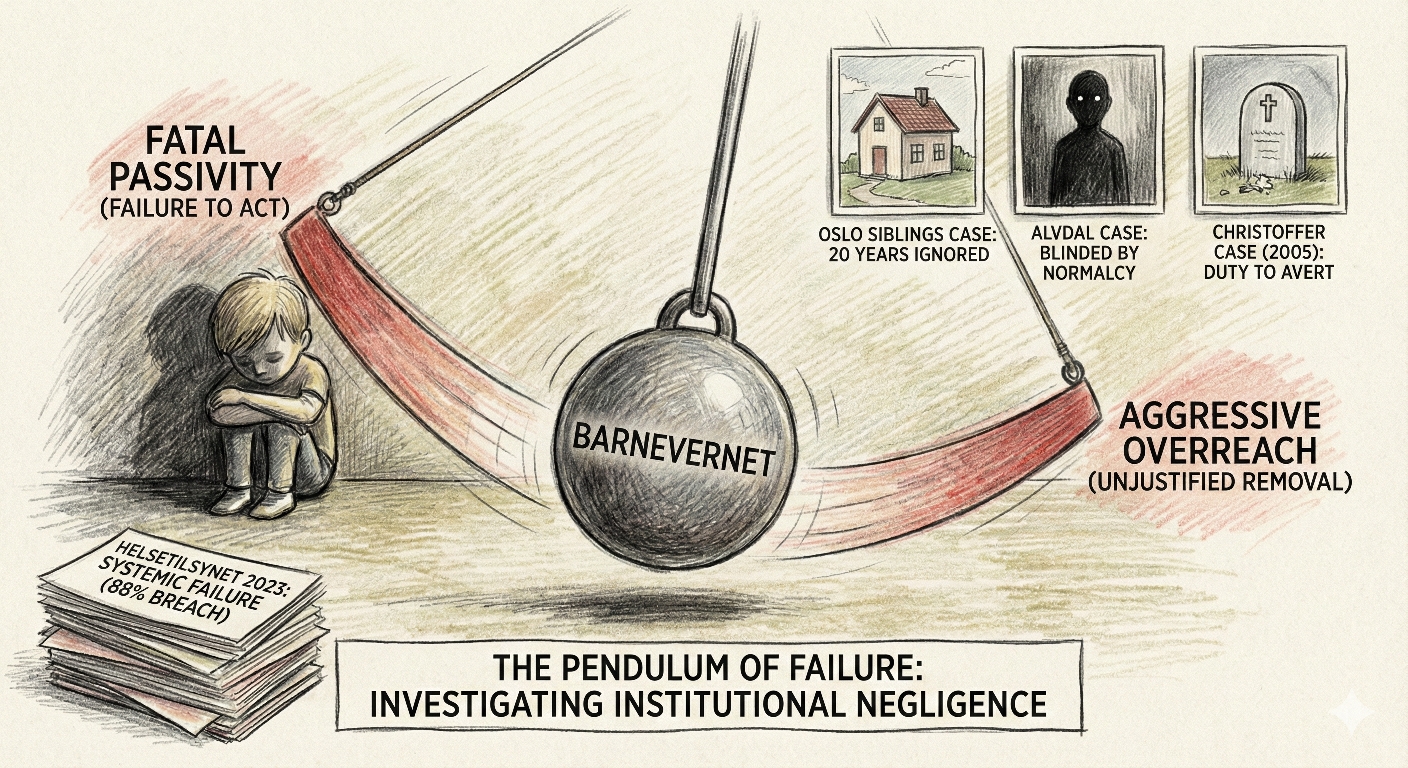
The Pendulum of Failure: Investigating Institutional Negligence
The criticism against Barnevernet (Norway's Child Welfare Services) is often viewed as a pendulum that swings between two extremes: fatal passivity (failure to act) and aggressive overreach (unjustified removal).
At Do Better Norge, we believe in a system that is both fair and vigilant. This investigation focuses on the first extreme—the systemic and specific failures where the state remained passive while children suffered in plain sight.
1. Systemic Evidence: The 2023 Helsetilsynet Reports
The most damning evidence of a "failure to act" comes from the Norwegian Board of Health Supervision (Statens helsetilsyn). Their recent audits indicate that the failure to protect children is not an outlier, but a systemic flaw.
- Systemic Failure (2022-2023): In a massive audit of 90 municipal services, Helsetilsynet found breaches of the law in 80 of them. The report concluded that a lack of quality in investigation work leads to far too many children having their needs overlooked.
- The Consequence: The state effectively admitted that in 88% of checked municipalities, the system was so disorganized that it "forgot" children in high-risk environments.
Source: Helsetilsynet: Svikt i åtte av ni barneverntjenester
2. High-Profile Cases of Negligence
Several landmark cases have reached the Norwegian courts, where the state was forced to pay record-breaking damages for its silence:
- The Oslo Siblings Case (2020): Five siblings were awarded 8.2 million NOK after Barnevernet ignored dozens of "notes of concern" regarding drug abuse and domestic violence for over 20 years. The court ruled the state failed its "duty of care."
- The Alvdal Case (2011): One of Norway's most horrific examples of passivity. Despite warnings, Barnevernet was "blinded" by the parents' outward appearance of normalcy, failing to see the trauma inflicted on the children.
- The Christoffer Case (2005): 8-year-old Christoffer Kihle Gjerstad was killed by his stepfather despite doctors and teachers reporting visible injuries. This tragedy sparked the "Christoffer-law" regarding the duty to avert crimes (avvergeplikt).
3. "Svikt og svik" (Failure and Betrayal)
In 2017, the government-appointed Barnevoldsutvalget released the report "Svikt og svik" (Failure and Betrayal), investigating 20 cases of severe violence and neglect.
- Institutional Slowness: In almost every case, the system acted too late.
- Medicalization: Abuse warnings were often dismissed as behavioral issues like ADHD.
- Silencing the Child: The committee found that Barnevernet rarely spoke directly to the child, relying instead on the parents'—the potential perpetrators'—version of events.
Source: Official Government Report: NOU 2017:12 Svikt og svik
4. Professional Criticism: The "Fear of Error"
The Children’s Ombudsman (Barneombudet) and the Norwegian Institution for Human Rights (NIM) have both pointed out that while Norway is criticized abroad for removals, the domestic reality is that many children are left in abusive homes because the legal threshold for removal is high and administrative capacity is low.
"While the international press focuses on 'state kidnapping,' the domestic reality in Norway is frequently defined by a fragmented municipal system where overworked caseworkers are easily manipulated by parents."
Summary of the "Failure to Act"
Institutional neglect is a quiet crisis in Norway. When Barnevernet fails to act, it is often due to bureaucratic paralysis and a failure to see past a parent's manipulation. We must demand better for our children.
Comments (0)
Please log in to post comments.
No comments yet. Be the first to comment!